
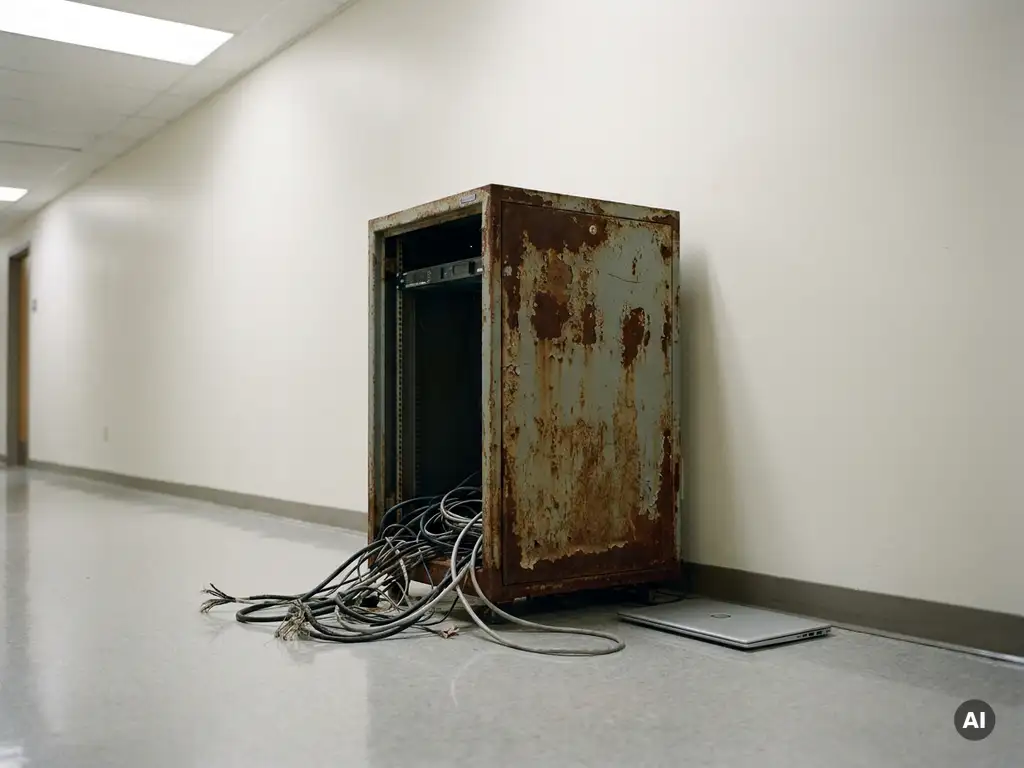
Legacy systems slow down municipal service innovation because they are built on outdated architectures that cannot easily integrate with modern tools, APIs, or cloud platforms. Municipalities become locked into rigid processes, making it difficult to launch new digital services, share data across departments, or respond quickly to changing citizen needs. The following sections break down exactly why this happens and what governments can do about it.
What makes a system count as a legacy system in government?
A government system qualifies as a legacy system when it was built on older technology that is no longer actively developed, difficult to integrate with modern platforms, and requires specialist knowledge that is increasingly rare. In practice, this means systems running on outdated programming languages, monolithic architectures, or on-premises hardware that cannot scale or communicate with newer tools.
Legacy systems in the public sector often share a recognizable set of characteristics:
- They were built decades ago and have been patched repeatedly rather than redesigned
- They rely on proprietary formats or closed databases that resist data sharing
- Documentation is incomplete or outdated, making changes risky
- The original developers have retired or moved on, leaving institutional knowledge gaps
- They run on hardware or operating systems that vendors no longer support
What makes government legacy systems particularly entrenched is that they often underpin critical public functions such as benefits payments, permit processing, or emergency services. Replacing them carries real operational risk, which is why many municipalities continue maintaining systems that are decades old rather than modernizing them.
How do legacy systems specifically block new municipal services?
Legacy systems block new municipal services primarily through integration failure. When a city wants to launch a digital service, such as an online permit application or real-time waste tracking, that service needs to pull and push data from existing back-end systems. If those systems cannot expose data through modern APIs, the new service either cannot function or requires expensive custom workarounds that slow delivery by months or years.
Beyond integration, legacy systems create friction in several specific ways:
- Data silos: Departments store information in incompatible formats, making cross-departmental services nearly impossible to build without manual data transfers
- Slow update cycles: Changing a legacy system to support a new service can take years of procurement, testing, and compliance review
- User experience limitations: Front-end citizen portals are only as capable as the back-end systems feeding them, meaning outdated infrastructure produces poor digital experiences regardless of how well the interface is designed
- Vendor lock-in: Many legacy systems are tied to a single vendor whose roadmap no longer aligns with the municipality’s innovation goals
The result is that innovation gets bottlenecked at the infrastructure layer. Even when a municipality has the political will and budget to launch a new service, the underlying technology creates a ceiling on what is actually possible.
What are the hidden costs of keeping legacy systems in place?
The hidden costs of maintaining legacy systems go well beyond the obvious licensing and maintenance fees. Municipalities that keep aging systems operational typically face rising operational costs, increasing security exposure, and a growing gap between citizen expectations and service delivery, all of which compound over time.
Some of the most significant hidden costs include:
- Specialist maintenance costs: As expertise in older languages and platforms becomes scarce, the hourly rates for maintaining legacy systems increase substantially
- Security vulnerabilities: Unsupported systems no longer receive security patches, creating exposure to data breaches and compliance failures under regulations such as GDPR
- Opportunity costs: Every euro spent maintaining an old system is a euro not spent on innovation, digital services, or citizen-facing improvements
- Productivity loss: Staff working with clunky legacy interfaces spend more time on manual processes, reducing overall departmental efficiency
- Failed integrations: Connecting legacy systems to modern tools often requires custom middleware that is expensive to build and fragile to maintain
Perhaps the most underestimated hidden cost is organizational inertia. When teams build their workflows around legacy systems, the institutional resistance to change grows alongside the technical debt, making modernization harder with every passing year.
Why is replacing legacy systems harder for municipalities than private companies?
Replacing legacy systems is harder for municipalities than private companies because public sector organizations operate under constraints that private businesses do not face, including procurement regulations, political accountability, limited IT budgets, and the obligation to maintain uninterrupted service delivery for citizens who depend on those systems.
Several structural factors make public sector legacy modernization uniquely challenging:
- Procurement rules: Government purchasing processes require competitive tendering, multiple approval layers, and long lead times that slow down technology decisions significantly
- Risk aversion: Unlike a private company that can accept service disruption during a migration, municipalities cannot take critical services offline without public and political consequences
- Budget cycles: Annual budget planning makes it difficult to fund multi-year modernization programs that require sustained investment
- Political turnover: Leadership changes between election cycles can interrupt or reverse long-term IT strategies before they deliver results
- Compliance requirements: Public sector systems must meet strict data governance, accessibility, and audit requirements that add complexity to any replacement project
These constraints do not make modernization impossible, but they do mean that municipalities need a more structured and phased approach than their private sector counterparts. Rushing a replacement without accounting for these realities is one of the most common reasons public sector IT projects fail.
What modernization approaches work best for public sector IT?
The modernization approaches that work best for public sector IT are those that reduce risk by delivering value incrementally rather than attempting a full system replacement in one go. Phased migration, strangler fig patterns, and API-led integration are consistently more successful in government contexts than big-bang replacements.
Phased migration and the strangler fig approach
The strangler fig approach involves building new capabilities alongside the legacy system and gradually routing functions to the modern platform until the old system can be decommissioned safely. This allows municipalities to modernize without disrupting live services. Each phase delivers measurable value, which makes it easier to sustain political and budgetary support across election cycles.
API-led integration as a bridge strategy
Before a full replacement is feasible, wrapping legacy systems with APIs allows new digital services to connect to existing data sources without requiring the underlying system to change. This bridge strategy is particularly effective for municipalities that need to launch citizen-facing services quickly while a longer-term modernization program runs in parallel. It reduces the integration bottleneck that most legacy environments create and buys time for a more deliberate replacement strategy.
Cloud migration, microservices architecture, and low-code platforms are also gaining traction in the public sector, particularly for services that do not touch the most sensitive legacy infrastructure. The common thread in successful approaches is modularity: breaking the problem into manageable pieces rather than treating modernization as a single, high-stakes project.
When should a municipality start its legacy modernization project?
A municipality should start its legacy modernization project as soon as any of the following conditions are present: the system is blocking the delivery of services citizens expect, maintenance costs are growing year on year, security risks are increasing due to unsupported software, or the vendor has announced end-of-life for the platform. Waiting for a crisis is consistently more expensive than proactive modernization.
Practical signals that indicate it is time to act include:
- New digital service projects are being delayed or cancelled because of back-end limitations
- IT staff are spending the majority of their time on maintenance rather than innovation
- The system cannot meet current data protection or accessibility regulations without significant workarounds
- Citizens are increasingly frustrated with slow, paper-based, or inaccessible services
- Neighboring municipalities or comparable organizations have already modernized and are delivering services yours cannot
The right moment to start is rarely when everything is stable and resources are plentiful. Most municipalities begin modernization under pressure, which is why starting with a clear assessment of the current system’s risks and a realistic roadmap is more important than waiting for ideal conditions.
How we help municipalities tackle legacy modernization
At Bloom Group, we specialize in helping public sector organizations and enterprises move beyond the constraints of outdated infrastructure and build digital services that actually work for the people who depend on them. Our approach is practical, phased, and grounded in the realities of government IT environments.
Here is what working with us looks like in practice:
- Legacy assessment: We map your current systems, identify integration bottlenecks, and prioritize modernization efforts based on risk and citizen impact
- API-led integration: We connect legacy back-ends to modern front-end services using API wrappers, enabling faster service delivery without requiring a full replacement upfront
- Custom application development: Our team builds web, mobile, and desktop applications tailored to your specific workflows, compliance requirements, and citizen experience goals
- Data engineering and architecture: We break down data silos and design data pipelines that allow departments to share information securely and efficiently
- Team as a Service (TaaS): We embed experienced developers and architects into your existing teams, providing the specialist expertise that legacy environments demand without long-term hiring commitments
- UX/UI design: We ensure that modernized back-ends are paired with citizen-facing interfaces that are intuitive, accessible, and genuinely useful
Every member of our team holds an advanced degree in Computer Science, AI, Mathematics, Physics, or Aerospace Engineering, which means we bring genuine technical depth to complex public sector challenges rather than generic consulting frameworks.
If your municipality is facing the limitations described in this article, the best next step is a direct conversation about your specific situation. Get in touch with us to discuss how we can help you move forward with a modernization approach that fits your constraints, your timeline, and your citizens’ needs.
Frequently Asked Questions
How long does a typical municipal legacy modernization project take?
The timeline varies significantly depending on the complexity of the existing systems, the number of integrations involved, and the modernization approach chosen. A phased approach using the strangler fig pattern or API-led integration can begin delivering measurable results within three to six months, while a full system replacement across multiple departments may span two to five years. Starting with a thorough legacy assessment helps set realistic expectations and allows you to sequence phases in a way that delivers early wins to maintain political and budgetary support.
What if our municipality cannot afford a full modernization program right now?
Full modernization does not have to happen all at once, and in most cases it should not. API-led integration and targeted microservice development allow municipalities to unlock immediate value — such as launching a citizen-facing digital service — without replacing the underlying legacy system upfront. Starting small with a clearly scoped pilot project not only reduces financial risk but also builds internal confidence and provides a proof of concept that can support future budget requests for broader modernization efforts.
How do we avoid vendor lock-in when modernizing our legacy systems?
The key is to prioritize open standards, interoperable APIs, and modular architectures from the outset rather than treating them as an afterthought. When evaluating new platforms or vendors, look for solutions built on widely adopted standards and avoid proprietary data formats that would make future migration difficult. Establishing clear data portability and exit clauses in vendor contracts is equally important, as is designing your architecture so that individual components can be replaced independently without requiring a full system overhaul.
What are the biggest mistakes municipalities make when starting a legacy modernization project?
The most common mistake is attempting a big-bang replacement — replacing everything at once — without accounting for the operational, political, and compliance risks involved. Other frequent pitfalls include underestimating the importance of change management and staff training, failing to involve end users and frontline staff in the design process, and starting without a clear baseline assessment of the current system’s dependencies and risks. Modernization projects that skip the discovery and planning phase almost always encounter costly surprises mid-delivery.
How do we get internal stakeholders and elected officials to support a modernization initiative?
The most effective approach is to frame modernization in terms of citizen impact and operational risk rather than technical necessity. Decision-makers respond more readily to arguments about service delays, security vulnerabilities, and rising maintenance costs than to discussions about architecture or programming languages. Presenting a phased roadmap with clear milestones, defined costs, and tangible outcomes at each stage also helps build confidence, as it demonstrates that the investment is manageable and that results will be visible before the full program is complete.
Can legacy modernization be done without disrupting live services that citizens depend on?
Yes, and this is precisely why phased approaches such as the strangler fig pattern are preferred in public sector contexts. By building new capabilities in parallel with the existing system and gradually shifting traffic to the modern platform, municipalities can modernize without taking critical services offline. API wrappers around legacy systems also allow new digital services to go live while the underlying replacement work continues in the background, ensuring continuity of service throughout the transition.
How do we know which legacy systems to prioritize for modernization first?
Prioritization should be based on a combination of risk, citizen impact, and modernization feasibility. Systems that pose the highest security risk due to unsupported software, create the most significant bottlenecks for new service delivery, or are causing the greatest citizen frustration should generally be addressed first. A structured legacy assessment that maps system dependencies, integration points, and compliance gaps is the most reliable way to build a prioritized modernization roadmap rather than making decisions based on assumptions or internal politics.