
Identity verification plays a foundational role in digital government services by confirming that the person accessing a service is who they claim to be. Without it, governments cannot safely deliver benefits, process tax returns, issue documents, or enable citizens to vote or register online. As governments worldwide accelerate their digital transformation, robust citizen identity verification has become the cornerstone of secure, accessible, and trustworthy public services. The sections below unpack how these systems work, what can go wrong, and what standards shape them.
How does identity verification actually work in digital government services?
In digital government services, identity verification works by matching the credentials a citizen provides against authoritative records held by the government or a trusted third party. The process typically involves collecting identifying information, validating it against a reference database, and then issuing a session token or digital credential that grants access to the requested service.
Most modern government identity systems follow a multi-step flow. First, a citizen provides a form of identity evidence, such as a national ID number, passport, or government-issued digital certificate. The system then cross-references this data against civil registers, population databases, or identity provider services. Once the match is confirmed, an authentication step, usually a one-time code, biometric check, or cryptographic signature, confirms that the person submitting the credentials is physically present and in control of the account.
The strength of verification is typically described in levels. Low-assurance verification may simply require an email address and a password. High-assurance verification, used for sensitive services like tax filings or welfare claims, demands stronger proof such as biometric matching or in-person document validation followed by digital credential issuance. The level required depends on the sensitivity of the service and the regulatory framework in place.
What are the most common identity verification methods used by governments?
Governments most commonly use eID cards, mobile identity apps, knowledge-based authentication, and biometric verification to confirm citizen identity online. The method chosen depends on the country’s infrastructure, the sensitivity of the service, and the digital literacy of the population being served.
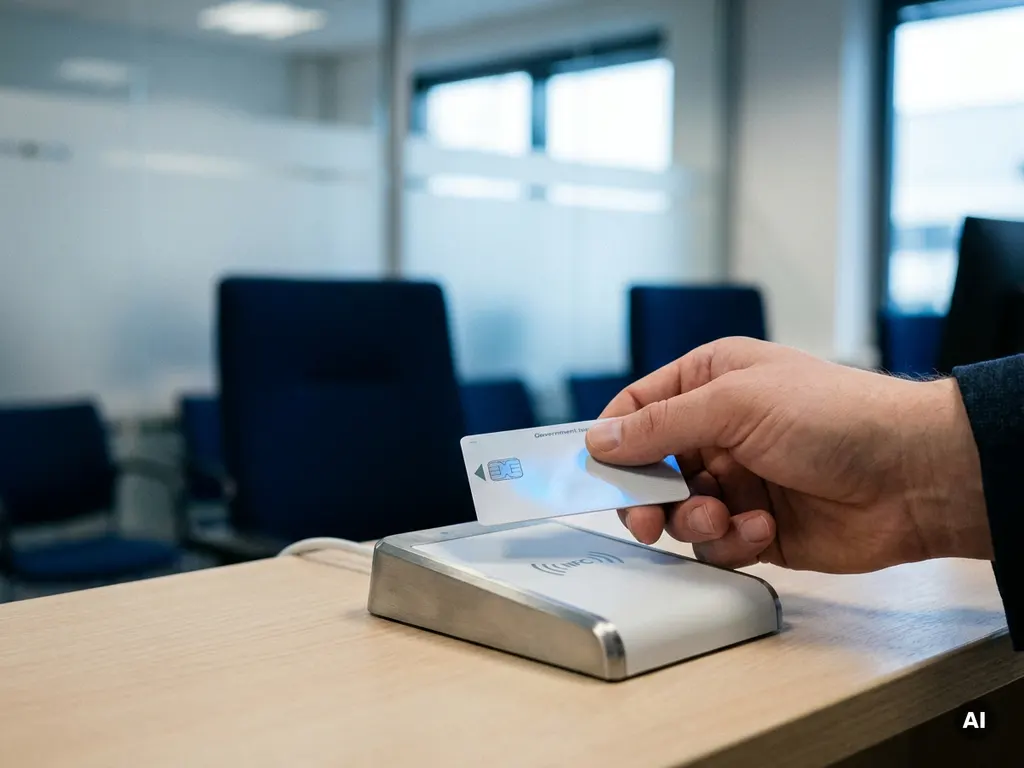
- eID cards and smart cards: Physical cards embedded with a chip that stores cryptographic credentials. Citizens insert the card into a reader or tap it against a device to authenticate. Used widely across the European Union.
- Mobile identity apps: Government-issued apps that use device biometrics and cryptographic keys to authenticate users. Scandinavia’s BankID and Belgium’s itsme are well-known examples.
- Knowledge-based authentication (KBA): Citizens answer questions derived from their official records, such as previous addresses or tax reference numbers. This is considered lower assurance and is being phased out for sensitive services.
- Biometric verification: Facial recognition or fingerprint matching against a stored reference, often used during initial enrollment or for high-assurance transactions.
- Federated identity via trusted providers: Governments partner with banks or telecoms that have already verified a citizen’s identity, allowing citizens to log in to government portals using credentials from those trusted institutions.
The trend in 2026 is toward mobile-first, biometric-backed digital identity wallets that citizens can use across multiple government and private-sector services, reducing the need to re-verify for every interaction.
What happens when identity verification fails for a citizen?
When identity verification fails for a citizen, they are typically denied access to the digital service and redirected to a manual fallback process, such as visiting a government office in person or contacting a help desk. Repeated failures can trigger account lockouts, fraud flags, or delays in receiving critical services like benefits or healthcare access.
Verification failures happen for several reasons. A citizen’s name may have changed due to marriage or legal process and not yet been updated across all government databases. Document details may be entered incorrectly, or the biometric system may fail to match due to poor lighting, camera quality, or changes in physical appearance. For elderly citizens or those with disabilities, biometric systems can present particular challenges.
The consequences of failure are not trivial. A citizen unable to verify their identity online may miss a tax deadline, be unable to claim an urgent benefit, or lose access to healthcare records during a medical event. This is why well-designed government digital identity systems must include accessible, clearly communicated fallback routes and human support channels. Designing these fallback journeys requires the same UX rigor as the primary verification flow itself.
How does identity verification protect against fraud in government platforms?
Identity verification protects against fraud in government platforms by ensuring that only the legitimate holder of a credential can access or modify sensitive records, claim benefits, or submit official requests. It prevents impersonation, account takeover, and the creation of synthetic identities that fraudsters use to exploit public services.
Without strong online government authentication, bad actors can file fraudulent tax refund claims, intercept benefit payments, or manipulate civil records. Multi-factor authentication and cryptographic identity verification make these attacks significantly harder because stealing a password alone is not enough to pass verification.
Liveness detection, a technique that confirms a biometric submission comes from a live person rather than a photograph or video, has become an important anti-fraud layer in high-assurance government services. Similarly, continuous authentication, where the system monitors behavioral signals during a session, can detect when a legitimate user hands over control to a fraudster mid-session.
Governments also use identity verification data to build risk-scoring models. Unusual login locations, mismatched device fingerprints, or verification attempts at atypical hours can trigger additional checks before granting access. This layered approach means fraud prevention is not a single gate but a continuous process throughout a citizen’s interaction with a digital service.
What privacy risks come with digital identity verification in government?
Digital identity verification in government carries privacy risks including unauthorized data aggregation, data breaches, biometric data misuse, and function creep, where data collected for one purpose is later used for another without the citizen’s knowledge or consent. These risks are significant because identity data is among the most sensitive information a government holds.
Biometric data presents a particular challenge. Unlike a password, a fingerprint or facial geometry cannot be changed if it is compromised. A breach of a biometric database creates a permanent privacy harm that no credential reset can fix. This is why many privacy advocates argue that biometric data should be stored locally on a citizen’s device rather than in centralized government databases.
Function creep is another serious concern. Identity systems built for tax administration have in some countries been extended to law enforcement surveillance or social credit scoring without public debate or legislative authorization. Transparent legal frameworks, independent oversight, and clear data minimization principles are essential safeguards against this.
Citizens also face risks from the aggregation of identity verification logs. Each time a citizen authenticates to a government service, a record is created. Over time, these records can reveal detailed patterns of behavior, health conditions, financial circumstances, and social relationships, even if no single record is sensitive on its own.
Which international standards govern government identity verification systems?
Government identity verification systems are governed by several international standards, most notably the eIDAS Regulation in the European Union, NIST Special Publication 800-63 in the United States, and ISO/IEC 29115, which defines an international framework for entity authentication assurance. These standards establish the assurance levels, technical requirements, and interoperability rules that national systems must meet.
- eIDAS (EU Regulation 910/2014 and its successor, eIDAS 2.0): Requires EU member states to recognize each other’s notified eID schemes and sets out assurance levels (low, substantial, high) for cross-border digital identity use.
- NIST SP 800-63: The US federal standard defining identity assurance levels (IAL), authenticator assurance levels (AAL), and federation assurance levels (FAL). Widely referenced beyond the US as a technical benchmark.
- ISO/IEC 29115: An international standard providing a framework for entity authentication assurance, aligned with but not identical to NIST 800-63.
- W3C Verifiable Credentials: An emerging web standard for expressing and exchanging digital credentials in a privacy-preserving, interoperable format, increasingly adopted in digital identity wallet initiatives.
- OpenID Connect and OAuth 2.0: Protocol standards widely used in federated government identity systems to allow citizens to authenticate once and access multiple services.
In 2026, the rollout of the European Digital Identity Wallet under eIDAS 2.0 is pushing governments to align their national systems with a common interoperability layer, enabling citizens to use a single digital identity across public and private-sector services throughout the EU.
How We Help with Digital Identity and Government Digital Transformation
At Bloom Group, we work with organizations navigating the complexity of digital government services, secure authentication architectures, and citizen-facing application development. Our team of highly educated developers and data specialists brings deep expertise to projects where identity, security, and user experience must work seamlessly together.
Here is how we support organizations in this space:
- Application development: We build secure, compliant web and mobile applications that integrate with eID systems, identity providers, and government authentication frameworks.
- UX/UI design: We design citizen-facing verification flows that are accessible, intuitive, and compliant, reducing drop-off and support burden.
- Data engineering and architecture: We help organizations structure identity data pipelines that respect privacy-by-design principles and meet regulatory requirements.
- AI and machine learning: We develop fraud detection models and risk-scoring systems that strengthen identity verification without compromising the citizen experience.
- Team as a Service (TaaS): We embed expert developers and architects directly into your team for greenfield projects or to accelerate existing identity platform initiatives.
If your organization is building or modernizing a digital identity solution, we would welcome a conversation. Get in touch with our team to explore how we can help you deliver secure, scalable, and citizen-centered digital services.
Frequently Asked Questions
How should a government agency decide which assurance level is appropriate for a given service?
The right assurance level depends on the sensitivity of the data involved, the potential harm caused by unauthorized access, and the regulatory obligations tied to that service. A useful starting point is to conduct a risk assessment that maps each service to the consequences of identity fraud or impersonation — a low-risk service like checking public transport schedules warrants low assurance, while filing a tax return or claiming welfare benefits demands high assurance. Frameworks like NIST SP 800-63 and eIDAS provide structured criteria for making this determination consistently across an organization’s service portfolio.
What is the best way to handle citizens who cannot complete digital identity verification due to age, disability, or lack of documentation?
Inclusive design requires that every digital identity journey has a clearly signposted, accessible fallback route for citizens who cannot complete online verification. This means offering in-person enrollment at accessible government offices, telephone-assisted verification for those with visual or motor impairments, and alternative document pathways for citizens who lack standard identity documents. The fallback experience should receive the same UX investment as the primary digital flow — a poorly designed fallback creates service exclusion and erodes public trust in digital government.
Can a government reuse an identity verification already completed for one service to grant access to another?
Yes, and this is precisely what federated identity and single sign-on (SSO) architectures are designed to enable. Standards like OpenID Connect and frameworks like eIDAS 2.0 allow a verified identity credential issued for one government service to be recognized and trusted by another, eliminating the need for citizens to re-verify repeatedly. However, this reuse must be governed by clear data-sharing agreements and legal authorization — the receiving service must have a legitimate basis for accepting that credential, and citizens should be informed when their identity is being shared across systems.
What are the most common mistakes organizations make when implementing a government identity verification system?
The most frequent mistakes include over-collecting identity data beyond what the service actually requires, neglecting the fallback journey for citizens who fail verification, and treating identity verification as a one-time gate rather than a continuous security layer. Another common pitfall is procuring a verification solution without assessing its accessibility impact — a system that works well for a 30-year-old smartphone user may systematically exclude elderly citizens or those with lower digital literacy. Involving real citizens in usability testing early in the design process, alongside security and compliance review, significantly reduces these risks.
How does the European Digital Identity Wallet (EUDIW) under eIDAS 2.0 change things for governments and citizens?
The European Digital Identity Wallet introduces a standardized, citizen-controlled digital credential store that works across all EU member states and can be accepted by both public and private-sector services. For citizens, it means carrying a single verified digital identity on their smartphone that can present only the specific attributes a service needs — for example, proving age without revealing a full birthdate. For governments, it means aligning national identity infrastructure with a common interoperability layer, which requires updating authentication endpoints, adopting W3C Verifiable Credentials, and ensuring existing services can accept wallet-based credentials alongside legacy eID methods.
How can organizations measure whether their identity verification process is performing well?
Key performance indicators for identity verification systems should cover both security and user experience dimensions. On the security side, track fraud detection rates, false acceptance rates, and the volume of account takeover incidents. On the UX side, monitor verification completion rates, drop-off points within the verification flow, and the volume of fallback or support requests triggered by failed verifications. A high fallback rate is often a signal that the primary verification flow has an accessibility or usability problem, not just a technical failure — both dimensions need to be reviewed together.
What should organizations prioritize when procuring or building a biometric verification component for a government service?
Three priorities stand out: accuracy across diverse demographic groups, data minimization, and liveness detection capability. Biometric systems have documented performance disparities across age, skin tone, and gender, so any procurement process should require vendors to provide disaggregated accuracy data across these groups before deployment. On data minimization, prefer architectures where biometric matching happens on-device or the template is discarded after verification rather than stored centrally. Finally, ensure the solution includes certified liveness detection to prevent spoofing attacks using photographs or pre-recorded video, which is a baseline requirement for any high-assurance government service.
Related Articles
- Why Are More Software Teams Returning to XP Principles?
- What Is the Difference Between Vibe Coding and No-Code?
- What Does Professional AI-Assisted Coding Look Like Compared to Vibe Coding?
- What Does a Sustainable Continuous Integration Strategy Look Like?
- What are the change management challenges with generative AI?